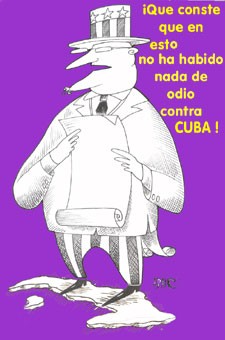
Cubadebate presenta un resumen de las nuevas medidas de Bush contra Cuba, contempladas en el Informe de la llamada Comisión de Asistencia para la Libertad en Cuba, presidida por Colin Powell, divulgadas esta tarde por el Departamento de Estado...
Bush considera que los tios, sobrinos y primos no son familiares de los cubanoamericanos. Los esposos, los hijos y los padres solo se podrán visitar cada TRES AÑOS!!! Y aun así tendrían que pedir permiso (una licencia específica). Establece también más dinero para los disidentes -de 7 millones a 36 millones, cada año-, y menos para los familiares. Más restricciones a las empresas que comercien con Cuba. Más dinero a las embajadas norteamericanas para acciones de propaganda contra Cuba. Aviones para la trasmisión de TV Martí...
Sumario Ejecutivo de las nuevas medidas de Bush contra Cuba, contempladas en el Informe de la llamada Comisión de Asistencia para la Libertad en Cuba, presidida por Colin Powell:
-Proporcionar 29 millones de dólares adicionales al Departamento de Estado, USAID y otros organismos pertinentes del Gobierno de los EE.UU. (en total, se le destinará un presupuesto actual de 36 millones de dólares para el financiamiento de la llamada "disidencia")
-Se ordena el despliegue inmediato de la plataforma aérea "C130 Comando Solo" y se le asignan fondos adicionales para la compra y el reacondicionamiento de una plataforma aérea dedicada a la transmisión hacia Cuba de Radio-TV Martí, lo que supuestamente es compatible con las obligaciones estadounidenses de telecomunicación internacional.
-Reducir, hasta una fecha que se anunciará próximamente, la cantidad de las remesas trimestrales que una persona puede enviar a un hogar cubano. De los 300 dólares permitidos, ahora solo se podrán enviar 225 dólares, pero restringidos solo a los familiares. (Según el informe, la cantidad de $75 al mes es razonable considerando que representa casi seis veces el promedio salarial cubano de 13 dólares por mes). Las ONG solo podrán remitir fondos a grupos "pro democráticos" e "independientes" de la sociedad civil y "víctimas de la opresión política y sus familias", y recibirán autorización para hacerlo con permiso específico.
-Reducir la manipulación que hace el régimen de Castro de las visitas de familiares para obtener dinero, y tratar de preservar al mismo tiempo los esfuerzos por promover los lazos familiares legítimos y la ayuda humanitaria al pueblo cubano de las siguientes formas:
Limitando las visitas familiares a Cuba a un (1) viaje cada tres años con permiso específico para ello. Las personas podrán solicitar un permiso específico a los tres años de su última visita. Los exiliados recién llegados de Cuba tendrán derecho a solicitar un permiso específico a los tres años de su salida de Cuba. Limitar la definición de "familia" para efectos de las visitas a los familiares más cercanos (abuelos, nietos, padres, hermanos, esposos e hijos)
-Reducir la cantidad de viáticos autorizados actualmente (la cantidad permitida para gastos de comida y alojamiento en viajes a Cuba), de 164 dólares por día a 50 dólares por día (que es aproximadamente ocho veces lo que un ciudadano cubano podría esperar ganar durante una visita de 14 días), en todas las visitas a familiares en Cuba, porque se supone que los viajeros se alojarán con sus familiares en Cuba.
-Para desalentar la inversión extranjera en Cuba en propiedades confiscadas, que son reclamadas por ciudadanos estadounidenses como dueños, hay que aplicar firmemente las sanciones de visa del Título IV en contra de los ciudadanos extranjeros que trafican en dichas propiedades (es decir, las usan o se benefician de las mismas), e incluso dedican recursos adicionales y personal para aplicar y hacer cumplir dicha la ley. Neutralizar a las empresas ficticias que son en realidad propiedad del Gobierno cubano, mediante el establecimiento de un Grupo de Evaluación de Bienes (Asset Targeting Group), en el que participe el personal de ejecución de la ley pertinente para investigar las nuevas formas en que se introducen y sacan divisas fuertes de Cuba.
-Proporcionar 5 millones de dólares adicionales para las iniciativas de diplomacia pública de las Embajadas de los Estados Unidos, con objeto de diseminar información en el extranjero sobre la política exterior estadounidense, especialmente en lo referente a los derechos humanos y otros acontecimientos en Cuba, incluidos el historial de Castro de dar acogida a terroristas, realizar espionaje en contra de los Estados Unidos y otros países, fomentar el derrocamiento de los gobiernos elegidos democráticamente en Latinoamérica, y la creencia del Gobierno de los EE.UU. de que Cuba cuenta por lo menos con un cierto nivel de investigación de armas biológicas ofensivas
-Financiar y promover conferencias internacionales o nacionales (en terceros países) para diseminar información en el exterior sobre las políticas estadounidenses respecto al esfuerzo de planificación para apoyar la "transición" en Cuba.
..........
A continuación, el texto íntegro de la Nota del Departamento de Estado
For Immediate Release Office of the Press Secretary May 6, 2004
Fact Sheet: Report of the Commission for Assistance to a Free Cuba
The objectives of United States policy towards Cuba are clear:
Bring an end to the ruthless and brutal dictatorship; Assist the Cuban people in a transition to representative democracy; and Assist the Cuban people in establishing a free market economy. To achieve these objectives, the President created the Commission for Assistance to a Free Cuba with a mandate to identify:
Additional measures to help the Cuban people bring to an end the dictatorship; and Elements of a plan for agile, effective, and decisive assistance to a post-dictatorship Cuba. In response to the mandate to support the hastening of democratic change in Cuba, the Commission recommended an integrated approach which pairs a more robust and effective effort to support the opposition in Cuba with measures to limit the regime's cynical manipulation of humanitarian policies and to undermine its survival strategies.
Immediate Actions:
Hastening the End of the Cuban Dictatorship
The President has directed that up to $59 million over the next 2 years be committed to implementing key Commission recommendations including: Up to $36 million to carry out democracy-building activities, support for the family members of the political opposition, and to support efforts to help youth, women, and Afro-Cubans take their rightful place in the pro-democracy movement; Up to $18 million for regular airborne broadcasts to Cuba and the purchase of a dedicated airborne platform for the transmission of Radio and Television Mart into Cuba; and Provide $5 million for public diplomacy efforts to disseminate information abroad about U.S. foreign policy, including Castro's record of abusing human rights, harboring terrorists, committing espionage against other countries, fomenting subversion of democratically-elected governments in Latin America, and other actions which pose a threat to United States national interests. The President has also directed that the following actions be taken to deny resources and legitimacy to the Castro regime: Eliminate abuses of educational travel programs through tighter regulations; Counter the regime's manipulation of our humanitarian policies by: Limiting recipients of remittances and gift parcels to immediate family members, while denying remittances and gift parcels to certain Cuban officials and Communist Party members; Stepping up law enforcement and sting operations against "mule" networks and others who illegally carry money; Limiting family visits to Cuba to one trip every three years under a specific license to visit immediate family (grandparents, grandchildren, parents, siblings, spouses, and children) (new arrivals from Cuba would be eligible to apply for a license 3 years after leaving Cuba); and Reducing the authorized per diem amount for a family visit (the authorized amount allowed for food and lodging expenses for travel in Cuba) from $164 per day to $50 per day (8 times a Cuban national's likely earnings in a 14-day visit). Neutralize Cuban government front companies by establishing a Cuban Asset Targeting Group made up of law enforcement authorities to investigate and identify new ways hard currency moves in and out of Cuba; Support and work with NGOs and other interested parties to help Cuban citizens access the Inter-American Commission on Human Rights (IACHR) and to provide in-country training to help to prepare claims for the IACHR; Ensure that Cuban independent labor representatives are able to engage with the International Labor Organization, and to draw attention to exploitative labor conditions in Cuba and to assist Cuban workers in obtaining redress; and Target regime officials for visa denial if they (1) are or were involved in torture or other serious human rights abuses or (2) provided assistance to fugitives from U.S. justice. The President has directed the establishment of a Transition Coordinator at the State Department to facilitate expanded implementation of pro-democracy, civil-society building, and public diplomacy projects and to continue regular planning for future transition assistance contingencies. Plans to Assist a Free Cuba Transition to Democracy and a Free Market Economy:
The Commission has worked and will continue to work with interested parties to develop recommendations to help the Cuban people recover the lost decades of the Castro years. These recommendations are not a prescription for Cuba's future, but an indication of the kind of assistance the international community should be prepared to offer a free Cuba. These recommendations will serve as the basis for a process of engagement with other countries, and international organizations to ensure that they too are prepared to support a Free Cuba. The recommendations outline how the United States could assist a free Cuba to: Consolidate the transition and build a strong democracy based upon democratic institutions, the rule of law, and respect for human rights; Meet the basic needs of the Cuban people in the areas of health, education, housing, and human services, while the Cuban people sweep aside the consequences of decades of cynical decisions by the regime to concentrate resources on sustaining the repressive apparatus; Create the core institutions of a free economy, unleashing the creative potential and entrepreneurial spirit of the Cuban people which have for too long been stifled by the regime; Modernize infrastructure so that it can support humanitarian efforts and the growth of a modern, vibrant economy; and Recover and safeguard its environmental assets and ensure that they are put to use for the benefit of the Cuban people.
For the Entire Commission Report visit:http://state.gov/p/wha/rt/cuba/